On World Maritime Day, the voyage from ancient paddles to low-carbon shipping offers a simple lesson: maritime progress depends on technology, but it succeeds only when sound rules become effective national practice.
Long before the modern engine room, human beings moved across water by muscle and wind. Early craft relied on paddles and oars. Sail then gave mariners the power to cross longer distances, establish trading routes and connect societies that had previously been separated by oceans. Yet sailing ships remained dependent on weather. Their speed and arrival times could not be guaranteed, and that uncertainty limited trade.
The steam engine changed that relationship with the sea. During the 19th century, paddle wheels and later the screw propeller enabled ships to move more reliably without waiting for favourable winds. Iron and steel hulls grew larger and stronger. By the end of that century, the steam turbine offered greater power and smoother operation. In the early twentieth century, marine diesel engines began another transition. Their fuel economy and operating efficiency eventually made diesel the dominant source of propulsion for most merchant ships.
Today, propulsion is entering a new period of change. Conventional engines still move most world trade, but the industry is testing and adopting cleaner fuels, battery systems, fuel cells, wind-assisted propulsion and more efficient voyage planning. The question has evolved from how to move a ship across the sea to how to do so safely, affordably and with far lower greenhouse gas emissions.
The industry hidden in everyday life
For many people, the maritime industry begins and ends with the image of a large ship on the horizon. In reality, it is an extensive system of ships, ports, people, laws, finance, engineering and logistics. UN Trade and Development estimates that more than 80 per cent of international trade in goods by volume is carried by sea. The maritime industry therefore sits quietly behind the food we eat, the fuel we use, the medicines in our hospitals, the vehicles on our roads and the phones in our hands.
Shipping is only one part of the wider maritime economy. The sector includes ship operations and port management, shipbuilding and marine engineering, fisheries and aquaculture, offshore energy and minerals, maritime tourism, ocean research, education and training. Within merchant shipping, different vessels serve different needs. Bulk carriers move unpackaged commodities such as grain, bauxite, manganese, coal and cement. Tankers carry crude oil, petroleum products, chemicals and liquefied gases. Specialised ships transport vehicles, refrigerated cargo, livestock or heavy equipment. Passenger ships and ferries carry people, while offshore vessels support energy operations at sea.
Liner shipping is the closest maritime equivalent to a scheduled public service. Container ships call at advertised ports on established routes and timetables. Tramp ships, by contrast, go where cargo and commercial opportunity are available. Both models matter, but liner shipping made global supply chains visible and predictable.
The box that changed world trade
The container revolution explains much of the modern maritime world. Before containerisation, general cargo could spend days or weeks in port while stevedores loaded separate bags, barrels, crates and machines. The work was slow, labour-intensive and vulnerable to damage and pilferage. From the 1950s, Malcolm McLean advanced the use of standard metal boxes that could move between truck, train and ship. In 1966, Sea-Land began a deep-sea container service using dedicated ships, cell guides and shore gantry cranes.
A standard container allowed cargo to remain sealed while moving through several modes of transport. Port stays fell dramatically, cargo-handling productivity rose and the whole transport chain became easier to plan. It also demanded huge investment in stronger quays, deeper berths, cranes, storage yards, information systems and larger ships. Containerisation did not merely change the ship. It changed ports, cities, trade routes, employment and the organisation of shipping companies.
Consider an ordinary football on a shop shelf. It is packed at a factory, placed in a container, moved by road or rail to a terminal, stacked in the yard, loaded onto a ship, carried across the ocean, discharged at another port and delivered through a distribution centre to the retailer. Customs officers, freight forwarders, terminal operators, seafarers, pilots, tug crews, surveyors, insurers and regulators all contribute. What looks like a simple consumer purchase rests on a complex maritime chain.
Ships have nationality and rules
A ship is not an anonymous object roaming an unregulated ocean. It must be registered in a State, fly that State’s flag and comply with national and international requirements. The flag State exercises legal and technical responsibility over the vessel. Classification societies establish and verify technical standards for hulls, machinery and equipment, while port States inspect visiting foreign ships and may detain those that present serious deficiencies.
The United Nations Convention on the Law of the Sea provides the wider legal order for the oceans. It defines maritime zones and balances the rights and duties of coastal States, flag States and the international community. The International Maritime Organization develops the global rules that make shipping safer, more secure and environmentally responsible. These include the SOLAS Convention on safety of life at sea, MARPOL on pollution prevention, the STCW Convention on the training and certification of seafarers, and the ISPS Code on ship and port security.
These instruments can appear remote from daily life, but their purpose is practical. Watertight subdivision helps a damaged ship remain afloat. Navigation and distress systems help rescuers find people in danger. Crew certification ensures that trained professionals operate complex vessels. Pollution rules protect coastal communities and marine ecosystems. Security measures reduce the vulnerability of ships and ports to unlawful acts.
World Maritime Day and the implementation test
World Maritime Day 2026 will be observed on 24 September under the theme ‘From Policy to Practice Powering Maritime Excellence’. The theme speaks directly to the central challenge of maritime governance. International rules achieve little if they remain in convention texts, meeting reports or policy statements. Governments must incorporate them into national law. Administrations must train personnel, conduct surveys and inspections, investigate casualties, share information and enforce standards consistently. Companies must maintain ships and protect workers. Ports must turn requirements into safe and efficient procedures. Seafarers and shore-based professionals must apply them every day.
The theme also reminds us that excellence cannot be measured only by the number of conventions a country has ratified. The real measure is whether a ship is seaworthy, whether a seafarer returns home safely, whether cargo passes through a port efficiently, whether pollution is prevented and whether institutions can respond when something goes wrong.
What this means for Ghana
Ghana’s prosperity is inseparable from the sea. The ports of Tema and Takoradi connect our producers and consumers to global markets and support trade with neighbouring landlocked countries. Tema is Ghana’s largest port and principal container gateway. Takoradi remains central to mineral, agricultural and energy-related exports. Ghana Ports and Harbours Authority data show that Takoradi handled 77.4 per cent of Ghana’s seaborne exports in 2024. These are not simply port statistics. They reflect jobs, public revenue, industrial inputs and the competitiveness of Ghanaian businesses.
Ghana must therefore view maritime capability as national economic infrastructure. Port expansion must be matched by efficient clearance, reliable road and rail links, modern digital systems, transparent charges and skilled personnel. Work already under way at Tema to improve port-call optimisation can reduce waiting time, fuel consumption and emissions. That practical collaboration among the Ghana Maritime Authority, Ghana Ports and Harbours Authority, terminal operators, Customs, Immigration, Port Health and shipping lines captures the meaning of policy moving into practice.
Safety and security require the same seriousness. Ghana operates in the Gulf of Guinea, where piracy, armed robbery, illegal fishing, drug trafficking and other organised maritime crimes can undermine trade and coastal livelihoods. Effective implementation demands coordination among the maritime administration, Navy, Marine Police, ports, fisheries authorities, intelligence services and prosecutors, supported by regional cooperation. Ships and ports must also strengthen cyber resilience as navigation, cargo documentation and terminal operations become increasingly digital.
The transition to cleaner shipping presents both risk and opportunity. New international measures may increase costs for developing countries that depend heavily on imported goods and have limited access to zero- and near-zero-emission fuels. Currently at the IMO, Ghana supports the global ambition while insisting on an equitable transition, predictable finance, technology transfer and capacity-building. At home, we must prepare ports for future fuels, improve energy efficiency, develop credible national emissions data and ensure that Ghanaian institutions and businesses are not left behind.
People remain the industry’s most important asset. Ghana should expand high-quality maritime education, sea-time opportunities and employment pathways for its seafarers. The Regional Maritime University can serve as a stronger regional centre for training in green shipping, digital navigation, port technology, maritime law and safety. More women must enter technical, operational and leadership roles. Young people should see the maritime sector not as a distant world of ships, but as a field offering careers in engineering, logistics, law, economics, information technology, environmental science and security.
A national maritime culture
World Maritime Day should leave Ghana with more than a ceremony. It should deepen public understanding of how the sea supports national life and renew our commitment to competent institutions. A maritime nation must know its waters, protect its coastline, enforce its laws, support its seafarers and make its ports competitive. It must also participate actively where international rules are negotiated, because decisions taken at the IMO eventually affect freight costs, port investment, ship operations and Ghanaian households.
The story of propulsion is a story of human progress: from the paddle, to sail, to steam, diesel and the search for cleaner power. Yet machinery alone has never been enough. Every advance depends on people, infrastructure and rules that work in practice. That is the deeper meaning of this year’s theme. For Ghana, maritime excellence will be powered when international commitments become national law, institutional capacity and measurable results at sea and ashore.
Selected sources
• International Maritime Organization, World Maritime Day theme 2026-2027, From Policy to Practice Powering Maritime Excellence.
• UN Trade and Development, Review of Maritime Transport 2025.
• Ghana Ports and Harbours Authority, Port of Tema and Port of Takoradi information and statistics.
• IMO GreenVoyage2050, Port of Tema port-call optimisation initiative, 2026.
• National Museum of American History and IMO, materials on the development and future of marine propulsion.
• Author’s teaching materials on ships, registration and classification, containerisation, liner shipping and the law of the sea.
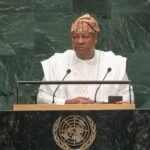
By Dr. Evans Ago Tetteh
Alternate Permanent Representative of Ghana to the International Maritime Organization