


Just weeks to the presidential elections in Ghana, middle-class concerns about illegal, irresponsible, and environmentally catastrophic gold mining have reached fever-pitch, completely derailing the campaign messaging themes of the leading political parties.
There are protests, strikes, threats of strikes, and hints of protests.
I have chronicled the journey of how Ghana got here in a previous essay.
Ghana made a Faustian pact to get to the top of Africa’s gold leagues
One way to look at the whole situation is that Ghana’s race to the top of the gold-production charts in Africa was fueled by the steroids of irresponsible mining.
When the country overtook South Africa in 2018 as Africa’s largest gold producer, both countries were bogged down in domestic fights over illegal mining.
Avoiding the costs and inconveniences of building strong institutional foundations for gold production helped accelerate Ghana’s massive gold rush, and ensuing gold boom.
Though one could also argue that the Ghanaian authorities were more mindful than their South African counterparts of the potential violence that could be unleashed if they pushed too far, the incontrovertible fact is that the country’s accommodating approach has boosted output.

The laxity in regulating small-scale mining in Ghana led to this sector accounting for over 40% of total production in 2018 even though Ghana purported at that time to have banned the practice, beginning in February 2017, and didn’t officially lift the “ban” until in December 2018.

Facts are always debatable in Ghana
The process by which “banned” miners somehow propelled Ghana into becoming Africa’s number one gold producer reflects a general situation where the “facts” of official policy and practice often diverge heavily from the reality on the ground. Elsewhere, I have described this “adhocracy” in detail.
Whether or not one can trust any of the official facts, data, and statistics, on the strength of which Ghanaian authorities are purporting (or is it, “pretending”?) to manage the mining industry is a question that has seen some dramatic responses in recent weeks.
After a high-profile opposition party figure accused the government of dishing out mining licenses like candy, it was natural to expect pushback from ruling party types. The more important issue of whether the nature of recent licenses, in terms of their environmental impact, have changed (most experts say, “yes”), took a backseat as the political party fanatics battled it out.
My own interest in analysing whether sudden upticks in license issuance can be matched with corresponding increases in the capacity at the Minerals Commission, the primary regulator, to properly scrutinise the applications and monitor mining activities at the approved concessions (answer: “no”) also got no traction.
After the Minister in charge sacked the 9 district mining inspectors in 2017, it took three years for the authorities to attempt reconstituting the inspectorate regime. Even now, insiders say that there are less than 40 qualified inspectors for the whole country.
The mysterious Minerals Commission license list
None of these policy matters received much attention. Instead, ruling party affiliates circulated a “fact sheet”, ostensibly containing data supplied by the Minerals Commission, in the name of one of Ghana’s fact-checking organizations purporting to show that the opposition party, when it was in government, issued more licenses than the current, ruling, party.

Fact-checking organizations dismissed the “fact sheet” as fake.
Partisan hacks tossing data about to upstage rivals is a tolerable feature of competitive democracies. And when you have been in the trenches of policy activism for nearly two decades as I have, you learn to triangulate data sources to arrive at the most accurate picture of any policy matter, anyway.
I myself miscommunicated on social media by not distinguishing among the eight different mining authorizations issued in Ghana in my bid to explain concerns that aggressive ramping up of licensing not matched by an increase in the number of application reviewers and inspectors is one of the ways in which Ghana lost control of small-scale mining regulation.
We can all live with some data confusion in view of the well-known capacity issues at various levels of key institutions. Misspecification, definitional inconsistencies, and sheer sloppiness in transcription, are all known to occur.
The Minerals Commission joins the fray
What is harder to live with is government institutions themselves appearing to manipulate data and, even worse, hide and distort it to deflect attention from mismanagement or even malfeasance.
Two days ago, the Minerals Commission itself seemed to have joined the fray of pushing the discredited fact-sheet designed to push a single partisan and deceptive agenda around the number of licenses issued under the two successive governments. Devoid of any analytical context.
When public servants hired to serve in strictly non-partisan institutions, particularly regulatory agencies, start to do that, I always wonder whether they are, perhaps, in cahoots with some shadowy politicians in some underhand schemes. So, I decided to take an even closer look.
Why natural resource data manipulation is dangerous in Africa
It is important, first and foremost, to appreciate the political economy of mining data in Africa. For many, many, years, poor transparency and data manipulation enabled weak accountability and, through that, corruption and mismanagement of natural resources.
In some countries, such as Angola, poor data practices and lack of transparency have been linked to missing revenues assessed in billions of dollars.
To tackle this challenge, a new global standard called EITI was launched at the World Summit on Sustainable Development in 2002. In 2023, the standard was augmented to better serve stakeholders.
In Ghana, EITI (GHEITI) is managed by a local secretariat hosted at the Ministry of Finance but overseen by a steering committee with representatives from diverse institutions, including civil society organizations.
One general goal of the GHEITI process is to ensure that data is collected, analyzed, and disseminated in an open and transparent manner, involving multiple stakeholders, in order to ensure checks and balances.
It goes without saying that the potential abuse of data for partisan purposes or to deflect attention from serious policy challenges would go contrary to the GHEITI standard. GHEITI would seek to audit and validate data received for dissemination to avoid any such risks.
Why the conflicting data from GHEITI and the Minerals Commission?
How, then, can the data purportedly shared by the Minerals Commission be in conflict with data being disseminated by GHEITI? A count of licenses issued is a pretty straightforward statistical exercise, no?
Look, for instance, at the data on the number of small-scale licenses issued in Ghana in 2020, the last year for which audited GHEITI data on the subject is available. Data that according to GHEITI came from the Minerals Commission. Now, compare the figures with what is in the Minerals Commission table above.
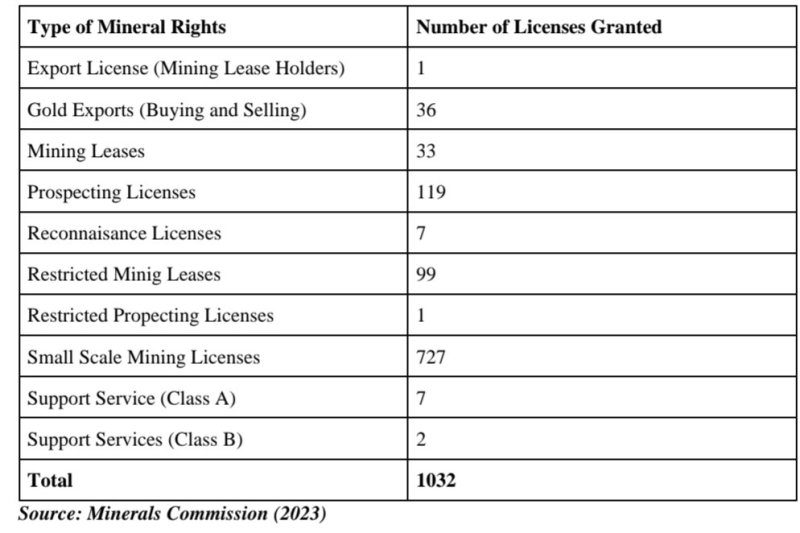
You would notice that the recently circulated Minerals Commission data on small scale mining licenses is nearly 20% lower than what the same Commission disclosed to GHEITI last year.
Minerals Commission keeps giving conflicting data to international organizations
In probing the issue, I discovered that the government of Ghana also gave different sets of data, coming from the same Minerals Commission to the Global Environment Facility (GEF), UNDP, and other international bodies in its application for grants to implement the Minamata Convention, a global effort to reduce mercury pollution.
Study the data in the table below carefully. It comes from the baseline assessment of the country’s current exposure to mercury pollution in 2018.
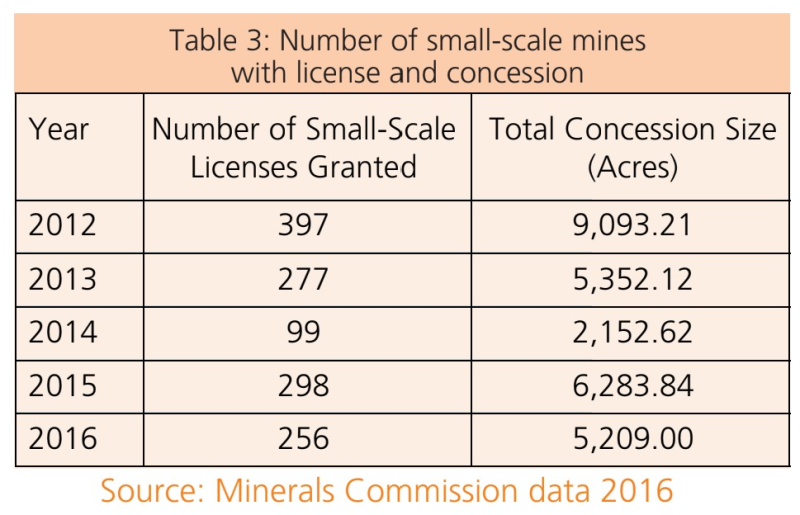
It shows that between 2013 and 2016, about 930 licenses were issued to cover about 19,000 acres of mining concessions (average of ~20 acres per license). Every single data point, however, differs materially from what is currently in circulation as official Minerals Commission data.
For example, whilst the data presented to the international organizations suggest that 256 licenses were issued in 2016, the presently circulating data says that the number of licenses issued that year to small-scale miners were 361, a whopping 40% variance.
But the real scary part is yet to come.
Baffled by the data discrepancies, I decided to mine official gazette data. By law, certain formal public acts must be gazetted, including certain actions of the Minerals Commission.
As I trudged through reams of official gazettes, nestling among information on marriage licenses and changes in matrimonial names, I began to see a strange pattern emerge.
First, very large tracts of land, of a far greater expanse than anything before, have been designated for small-scale mining since 2017.
For instance, the extent of land designated by the relevant Minister in June 2019 for small-scale mining in a single gazette notification was about 107 square kilometers or 26,500 acres.
If you have been paying attention, you would recall that, by comparison, only 19,000 acres were designated for small-scale mining in the four years from 2013 to 2016.
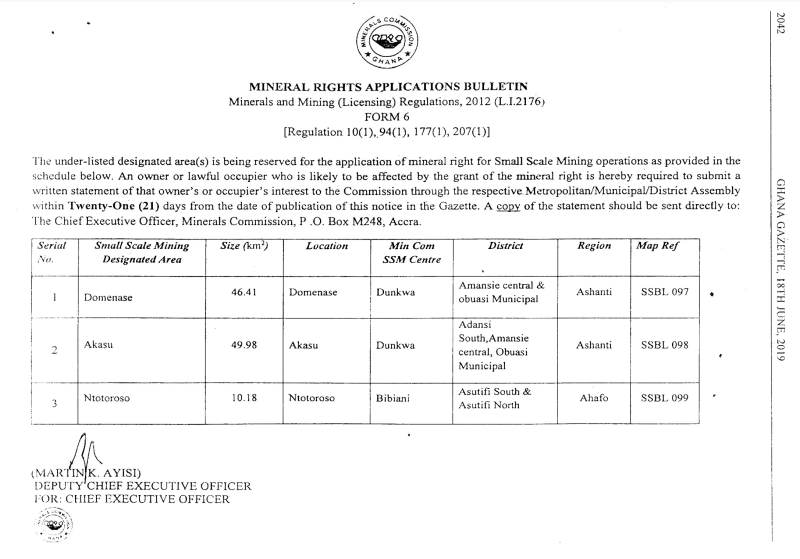
The situation in 2018 was even crazier.
In March 2018 alone, roughly 670 square kilometers, or 165,500 acres, of concessions were designated by the Minister in charge for small-scale mining.
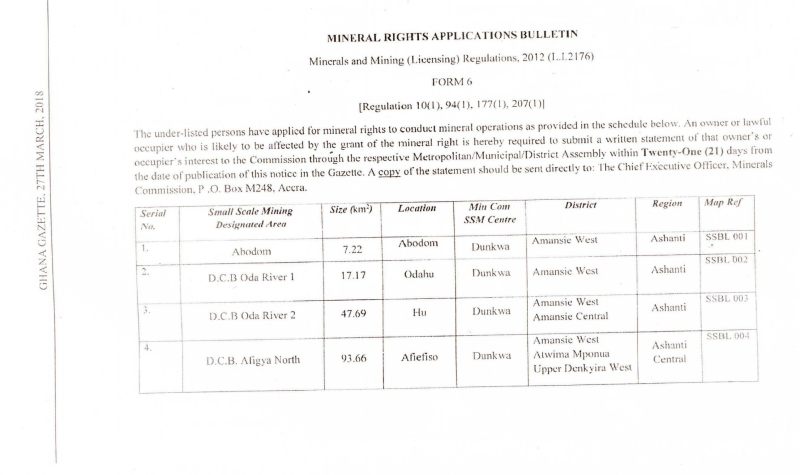
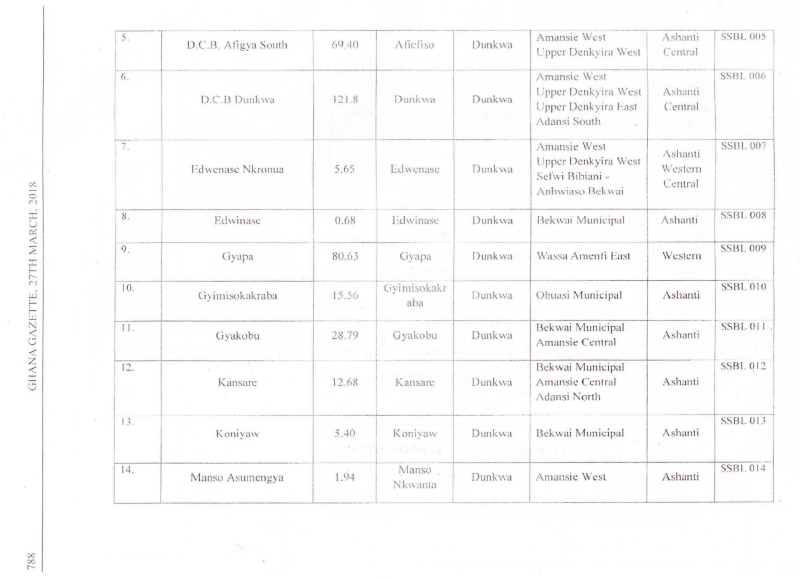
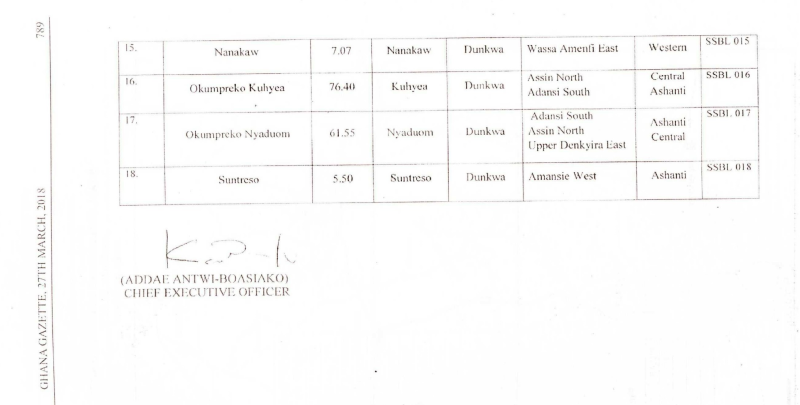
Now, here is the real problem. Small-scale mining leases are not published individually in the gazette. The Minerals Commission merely publishes the designated blocks. To infer how many leases are involved, you need to do some arithmetic.
The law caps the acreage assignable to a small-scale mining licensee at 25 acres. Hence, the inferred number of leases from the land designated for small-scale mining in March 2018 would be at least 6600!
The Dunkwa block alone should be able to accommodate 1200 small-scale mining licenses.
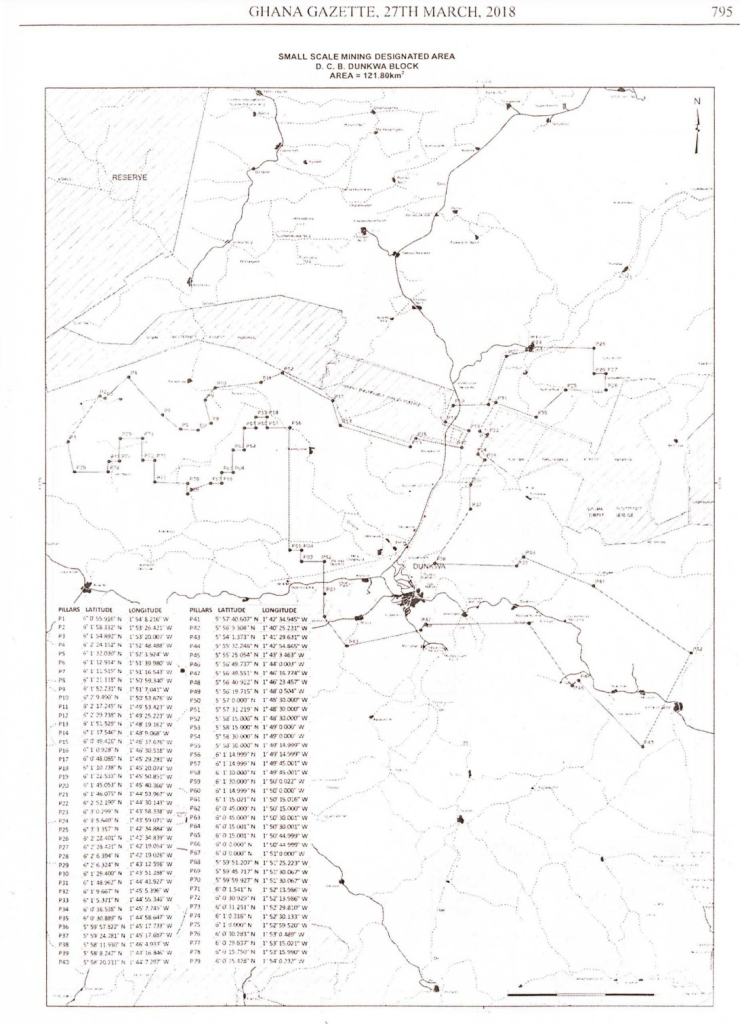
If the reader has been paying attention, the befuddlement must be overwhelming by now.
How come in a year when small-scale mining was supposedly banned, more implied small-scale licenses were anticipated for issuance in a single gazette notification than have ever been issued for small scale mining since 1988, just before small-scale mining was legalised? That actually doesn’t do the issue justice.
Look at the chart below by Martin Guenther, formerly a researcher at the University of London.

Simple inspection should tell the reader that the amount of land designated in March 2018 for small-scale mining was equivalent to all the land allocated between 2010 and 2017. The reader would also notice the significant variance between what the government reported to the international organizations and what this researcher found by tallying the actual concession acreage.
Yes, that’s right, nothing adds up
And, yet, as I have mentioned several times already, small-scale mining was banned between February 2017 and December 2018.
In fact, according to the Minerals Commission data making the rounds, only 7 small-scale mining licenses were issued in 2017 and NONE in 2018.
And, yet, 2018 was also the year that saw the highest small-scale gold production in Ghana’s history – ~2 million ounces! Miracles are real!
The next government should take this seriously
It clearly would not be hyperbole to suggest that the new government would need to thoroughly examine the stock of small-scale licenses in the country by, if practical, requiring re-registration and validation.
There is already huge concern about the “beneficial ownership” of natural resource concessions in Ghana that GHEITI and others are trying to get a handle on. That is to say that there have been persistent claims of politically exposed persons amassing concessions and using fronts to disguise their ownership and/or control.
The head of an interministerial body set up to fight the illegal mining canker in 2017 accused some board members of the Minerals Commission of selling concessions to illegal miners. The allegations were never properly investigated, nor were the results of any inquiries shared with the public.
It bears emphasizing that the practice has been to pack the board of the Minerals Commission with politicians even though it is meant to be an independent, scientific, organization.
From the short discussion above, it should be absolutely clear to all readers that the problems of transparency, accountability, anti-corruption, and sound governance, in the mining sector must start with a serious sanitisation of the Minerals Commission.
However, that cannot happen if the country can’t even agree on the basic data of what really is happening on the ground.


