There is something deeply contradictory about modern Ghana. On the international stage, our nation continues to rise. Our democracy remains one of the most respected on the continent. Our diplomats are making their mark globally. Ghanaian professionals, entrepreneurs, creatives and innovators continue to
excel across the world. Our voice is increasingly heard in important international conversations, and our country is widely regarded as a beacon of stability, peace and opportunity.
The world sees Ghana as a nation of promise.
Yet back home, another reality confronts us.
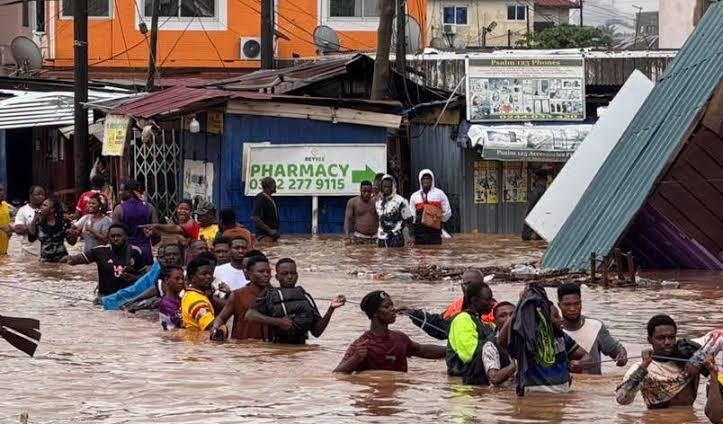
As torrential rains once again leave parts of Accra and other communities across Ghana submerged, we are reminded that our greatest development challenges are often not found on the international stage, but in the places we live every day.
Choked gutters.
Overflowing drains.
Plastic waste scattered across our communities.
Polluted water bodies.
Poor maintenance culture.
Public spaces that too often reflect neglect rather than national pride.
And so we must ask ourselves a difficult but necessary question:
How can a nation whose international reputation is rising so rapidly still struggle with some of the most basic elements of environmental stewardship, sanitation and public order? Because this conversation is not merely about cleanliness.
It is about national identity.
A nation’s environment reflects its values.
Its discipline.
Its priorities.
Its respect for present and future generations.
No truly great nation neglects the spaces its people inhabit every day.
As Ghana’s international profile continues to soar, our environment must rise with it.
Today, that conversation feels even more urgent.
As many parts of Accra and communities across Ghana once again experience heavy flooding
following persistent rainfall, countless families have seen roads become impassable, homes inundated, businesses disrupted and livelihoods threatened. Year after year, the story repeats itself.
While extreme weather cannot always be prevented, the scale of destruction often reflects challenges we have the power to address: inadequate drainage infrastructure, indiscriminate disposal of waste, encroachment on waterways, poor urban planning and inconsistent maintenance of our drainage systems.
Flooding is more than an inconvenience. It is a public safety issue, an economic challenge and a national development concern. It interrupts education, damages property, strains emergency services, affects businesses and, tragically, has too often cost lives.
If Ghana is to become the globally competitive nation we aspire to be, then building resilience against flooding must become part of our national development agenda. A cleaner environment, better planning, stronger enforcement and shared civic responsibility are no longer optional — they are essential.
We cannot celebrate diplomatic victories abroad while accepting environmental decline at home.
We cannot aspire to global excellence while tolerating local neglect. The next chapter of Ghana’s development must not only be visible in conference halls, foreign investments, international partnerships and global recognition.
It must be visible in our streets.
In our markets.
In our drainage systems.
In our parks.
In our communities.
And in the way we care for the environment entrusted to us.
This responsibility belongs to all of us.
To government, the time has come for stronger enforcement, greater investment in sanitation
infrastructure, improved drainage systems and sustained commitment to beautifying our towns
and cities.
To our Metropolitan, Municipal and District Assemblies, let cleanliness, maintenance, drainage
management and environmental protection become visible priorities.
To businesses and institutions, let us invest in cleaner surroundings and help create communities
we can all be proud of.
And to every Ghanaian, let us remember that patriotism is not only expressed through words.
It is expressed through action.
In how we dispose of waste.
In how we care for public spaces.
In how we protect our environment.
In how we stop treating drains and gutters as dumping grounds.
In how we hold ourselves and our leaders accountable.
The Ghana we proudly present to the world should increasingly reflect the Ghana we experience
at home.
As we celebrate our growing influence abroad, let us commit ourselves to building a cleaner,
greener, safer, more beautiful and more orderly nation worthy of its rising status.
For national pride is not only displayed on the international stage.
It is visible in the way we care for the place we call home.
The responsibility is ours.
The time is now.
And the Ghana we desire must begin with the Ghana we build together.