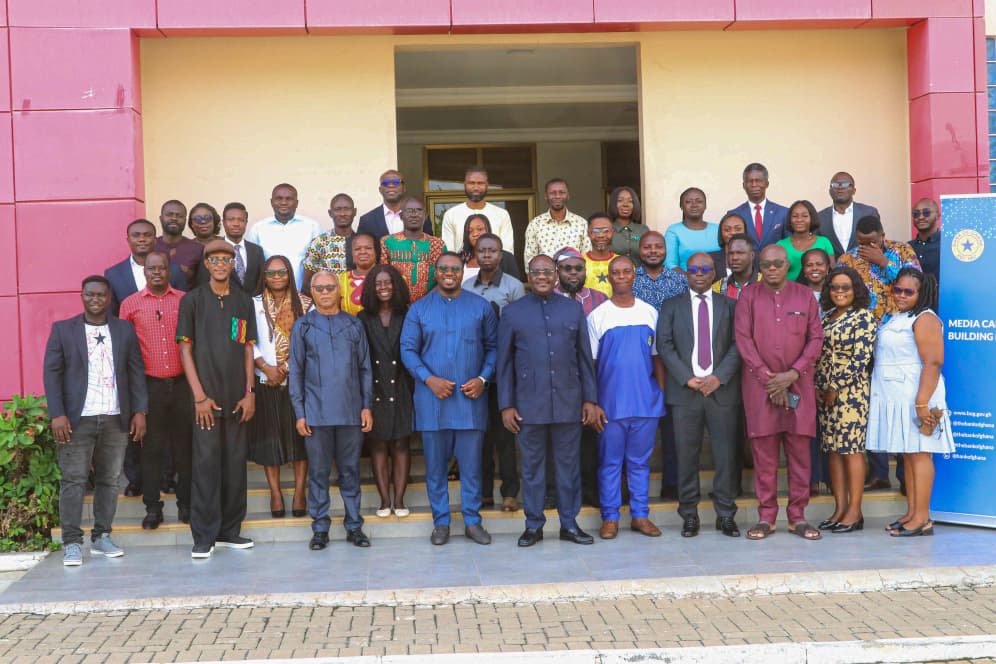
The Bank of Ghana (BoG) has organised a three-day media capacity-building training programme for journalists from the Central, Volta, Eastern and Ashanti regions to strengthen their understanding of monetary policy, financial markets, banking sector developments and responsible economic reporting.
The training, held at Eastern Premier Hotel in Koforidua, was organised in recognition of the media’s role as a critical bridge between economic policymakers and the public.
Addressing participants at the opening ceremony, the Director of Communications at the Bank of Ghana, Mr. Bernard Otabil, stressed the importance of accurate, contextual and balanced reporting of economic issues.
He warned that misinformation and disinformation remain a growing global concern with serious implications for economic stability.
According to Mr. Otabil, the World Economic Forum’s Global Risk Reports for 2024 and 2025 identified misinformation and disinformation among major risks likely to influence global attention and impact economic performance in the coming years.
He explained that economies and financial markets depend heavily on information and that inaccurate reporting can trigger negative consequences.
“Markets move on information. If the wrong information is published, investors and fund managers may act on it and suffer losses, which ultimately affects confidence and investment decisions,” he said.
Mr. Otabil expressed concern about the spread of fake news, particularly on sensitive economic indicators such as inflation, exchange rates and currency performance, noting that speculative reporting can drive panic and distort market behaviour.
He urged journalists to rigorously verify information and avoid sensational headlines, stressing that responsible reporting is essential to maintaining public confidence and economic resilience.
“The media has a powerful responsibility. Through accurate, balanced and responsible reporting, journalists can help build understanding, confidence and resilience within our economy,” he stated.
Mr. Otabil said the success of the training programme would be measured by improvements in the quality, accuracy and depth of economic reporting by participating journalists.
He noted that public understanding of economic policies significantly influences investor sentiment and behaviour in the financial sector, underscoring the need for stronger collaboration between the Bank of Ghana and the media to ensure reporting on monetary policy and financial stability remains accurate, contextual and solution-focused.
Touching on the broader economic outlook, Mr. Otabil stated that Ghana’s economy continues to show resilience despite global and domestic challenges.
He disclosed that the Composite Index of Economic Activity expanded by 12.6 per cent in March 2026, while inflation remained relatively stable at 3.7 per cent.
He further revealed that Ghana’s gross international reserves currently stand at approximately US$14.4 billion, providing a buffer against external economic shocks.
Mr. Otabil, however, cautioned journalists against relying solely on headline figures without considering their impact on people and businesses.
“Numbers alone do not tell the full story because behind every statistic are people, livelihoods and businesses,” he said.
He added that the media’s role extends beyond reporting data to explaining how policy decisions affect access to credit, business operations, employment and household welfare.
Mr. Otabil called for stronger collaboration between journalists and policymakers in advancing Ghana’s economic development agenda.
The Eastern Regional Chairman of the Ghana Journalists Association (GJA) Ampem Darko Koranteng Stephen called on journalists to uphold accuracy, context, and integrity in reporting financial and economic issues, stressing that irresponsible reporting can affect markets and livelihoods.
He Chairman noted that although many members of the public may not read the Bank’s Monetary Policy Reports, they rely heavily on media reports and headlines to understand developments in the economy.
He emphasised that inaccurate reporting on inflation, interest rates, and the performance of the Ghana cedi could create public anxiety and negatively influence economic confidence.
According to him, “what may appear to be a simple two-minute news item can have national impact,” adding that factual and diligent financial journalism should be regarded as an act of patriotism.
The Chairman urged journalists to understand key economic concepts before publication, including the distinction between policy rates and lending rates, and encouraged the media to go beyond figures to explain the reasons behind economic developments.
He further cautioned against sensational headlines and misleading narratives designed to attract attention, saying journalists must remain committed to ethical standards and public interest reporting.
Source: Starrfm.com.gh