By using this site, you agree to the Privacy Policy and Terms of Use.
Accept
Starr FmStarr FmStarr Fm
  • Home
  • Election Hub
  • General
    GeneralShow More
    Energy minister pushes faster completion of AKSA’s 900MW Takoradi power project
    June 5, 2026
    NUGS empowers young entrepreneurs to drive Ghana’s future at Agribusiness forum
    June 5, 2026
    Ghana needs a smart tunnel to solve flooding: Lessons from Kuala Lumpur for Accra’s future
    June 5, 2026
    EMSOG defends KATH over temporary suspension of emergency admissions, cites patient safety risks
    June 4, 2026
    Heavy rains in Accra push streetlight  poles onto Oyarifa Highway, causing gridlock and damage
    June 4, 2026
  • Business
    BusinessShow More
    Energy minister pushes faster completion of AKSA’s 900MW Takoradi power project
    June 5, 2026
    Eric Opoku unveils reforms to attract investment into Ghana’s rice value chain
    June 3, 2026
    COCOBOD to reduce reliance on foreign loans with local funding plan — Deputy CEO for Finance reveals
    June 3, 2026
    Naana Jane calls for investment in rice sector to cut food imports
    June 2, 2026
    Ghana partners Nebraska to reduce dairy imports and boost local production
    June 2, 2026
  • Politics
    PoliticsShow More
    Samreboi case: D-Day for Wontumi set for July 3
    June 3, 2026
    President Mahama does not order arrests – Shamima Muslim rejects claims
    June 3, 2026
    NDC can break the eight if government delivers – Shamima Muslim
    June 3, 2026
    Supreme Court dismisses IMANI’s case challenging President’s appointments of IGP, Director of Prisons others as lacking merit
    June 3, 2026
    Rectify procedural lapses in Anti-LGBTQ Bill to ensure its legitimacy – Catholic Bishops Conference to Parliament
    June 3, 2026
  • Entertainment
    EntertainmentShow More
    WatsUp On Campus kicks off tour featuring top artistes, 15 Universities in Ghana
    June 5, 2026
    Medikal, Kelvyn Boy, other stars shut down WatsUp On Campus with electrifying performances at RMU SRC artiste night
    June 1, 2026
    Kweku Smoke’s London concert showcases unity among Ghanaian artistes – MC Portfolio
    May 30, 2026
    Sarah Naana Wilson retains Foklex Entertainment Show Host of the Year Award
    May 30, 2026
    WatsUp TV heads to Rwanda for AfroTalks Kigali 2026
    May 27, 2026
  • Sports
    SportsShow More
    Ghana confirms participation in Glasgow 2026 Commonwealth Games
    June 3, 2026
    Joanita Borteyeman wins double gold as James Marfog retains title in Damba Table Tennis Championship
    June 2, 2026
    Queiroz names Black Stars squad for 2026 FIFA World Cup, 12 debutants earn historic call-ups
    June 2, 2026
    “We don’t just want to turn up” – Brandon Thomas-Asante targets World Cup success with Black Stars
    May 29, 2026
    Asante Kotoko seek new direction as Club targets UK-born Ghanaian coach Baffour-Akoto
    May 29, 2026
  • Technology
    TechnologyShow More
    Samsung Ghana expands access to AI-powered mobile experiences with the Galaxy A series
    June 2, 2026
    KNUST hosts FemSTEM Africa 2026 to empower the next generation of women health innovators
    June 2, 2026
    Samsung Ghana introduces 2026 Vision AI Mini LED TV for ultimate sports viewing experience
    June 1, 2026
    Redington appointed authorised distributor of Adobe Creative Cloud in Ghana
    May 25, 2026
    Samsung Galaxy A57 5G, A37 5G now available in Ghana
    May 25, 2026
  • International
    InternationalShow More
    UK, Ghana launch growth partnership to create jobs, boost infrastructure and skills development
    June 1, 2026
    Xenophobia: Gov’t to evacuate 500 more Ghanaians from South Africa – Foreign Affairs Ministry
    May 28, 2026
    Nana Oye Bampoe Addo leads Ghana’s delegation to UN Anti-Corruption Session in Vienna
    May 27, 2026
    QNET, Manchester City hold a football training programme for young talents in Accra
    May 22, 2026
    Government partners Portage Energy Group on waste-to-energy and aviation fuel project
    May 20, 2026
  • Factometer
Search
© 2024 EIB Network Ltd. All Rights Reserved.
Reading: Lessons from Kenya on how to boost breastfeeding rates
Share
Notification Show More
Font ResizerAa
Starr FmStarr Fm
Font ResizerAa
  • Headlines
  • Election Hub
  • General
  • Politics
  • Sports
  • Business
  • Entertainment
  • Factometer
Search
  • Headlines
  • Election Hub
  • General
  • Politics
  • Sports
  • Business
  • Entertainment
  • Factometer
Have an existing account? Sign In
Follow US
© 2024 EIB Network Ltd. All Rights Reserved.
Editors PickFeatures

Lessons from Kenya on how to boost breastfeeding rates

Starrfm.com.gh By Starrfm.com.gh Published August 1, 2019
Share
SHARE

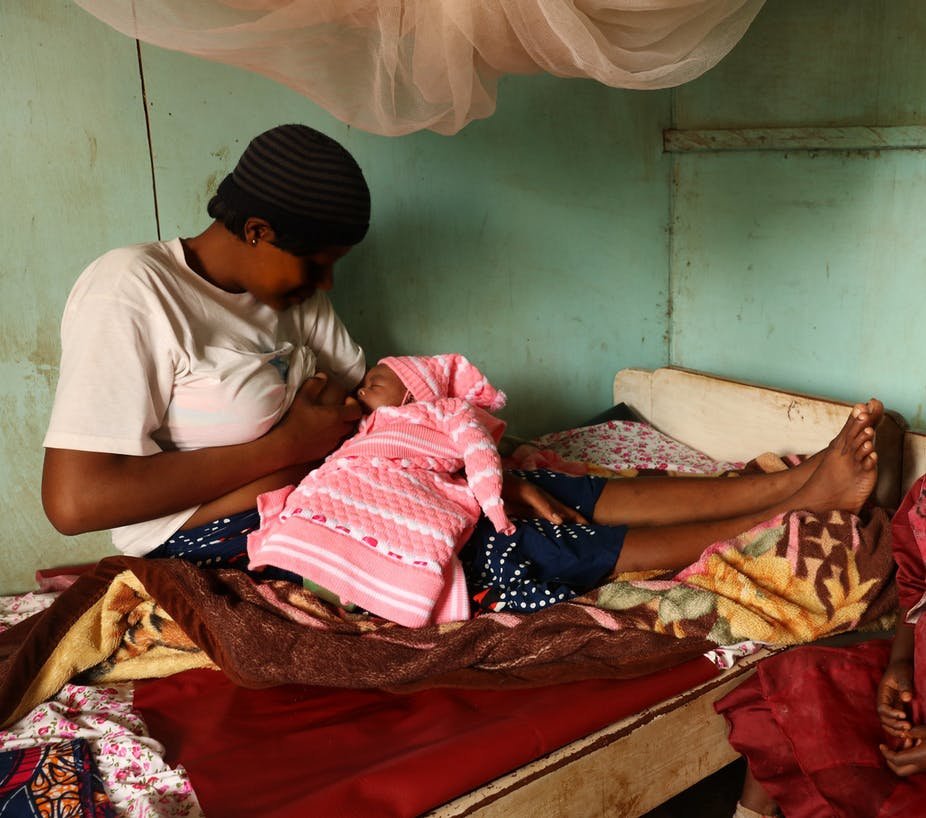
Kenya has, over the past two decades, made tremendous achievements in promoting breastfeeding. The number of babies who were exclusively breastfed rose from just 13% in 2003 to about 61% in 2014.

Contents
Home-based counsellingLessons for improvement

This was achieved largely because of two programmes led by the Ministry of Health: the Baby Friendly Hospital Initiative and the Baby Friendly Community Initiative. The hospital initiative promotes breastfeeding in hospitals at the time of delivery, while the community initiative promotes breastfeeding at home.

Breastfeeding is important. It lowers incidences of child illness and death and has also been linked to better outcomes at school. The World Health Organisation recommends that babies be breastfed immediately after they’re born, followed by exclusive breastfeeding for the first six months of their lives.

For over ten years scientists at the African Population Health Research Centre (APHRC), myself among them, have tried to tackle the challenges that still stand in the way of Kenya achieving its national target of getting 80% of women to breastfeed.

To do this, we focused our research on the Baby Friendly Community Initiative. Over the past five years, it’s been rolled out in several counties. The initiative recognises that many women deliver at home and need continued support after delivery.

Our studies, carried out in rural and urban settings, looked into how well home-based counselling worked. The aim was to see where improvements could be made. We also carried out an exercise across Kenya to understand community perceptions on how best to implement the initiative.

We found that the project was a success. Mothers developed confidence and knowledge about breastfeeding and felt supported by the community health workers. These health workers are volunteers motivated by goodwill and recognition for the work they do.

But more needs to be done. It is important to include fathers and others – such as grandmothers and traditional birth attendants – in implementing the project. Also, incentives should be given to community health volunteers to ensure they stay engaged.

Our hope is that the study will inform guidelines being developed by the Ministry of Health for scaling up the initiative.

Home-based counselling

To test the initiative, we designed a project that involved regular home visits by community health workers during a woman’s pregnancy and until the baby was a year old. It was implemented in two low-income settlements in Nairobi for almost two years.

The health workers taught mothers about nutrition, the immediate initiation of breastfeeding after birth, breast positioning and attachment and the importance of exclusive breastfeeding. Workers also explained how long and often they should breast feed for, how to express breast milk and how to store it.

It was hugely successful. Exclusive breastfeeding rates for the baby’s first six months rose from 2% to 55%.

The intervention also worked in rural areas. We implemented the study in Koibatek – a rural area in the Rift Valley area. Over 87% of the mothers who received counselling breastfed exclusively for six months, compared to 43.8% at control sites.

In addition to these two studies, in partnership with Kenya’s Ministry of Health, we conducted an exercise across the country to get insights into what communities thought was the best way to implement the Baby Friendly Community Initiative and what the role of different stakeholders – like fathers, grandmothers, community leaders, traditional birth attendants and community health volunteers – should be.

Lessons for improvement

The key lesson was that consistently supporting mothers to breastfeed through home-based personalised care worked. This was partly because the health workers came from their community and so the women trusted them more. The health workers were also more accessible than other health care providers, like hospital nurses.

When it came to the role of the different stakeholders, the community suggested that fathers and other key influencers of infant feeding – like grandmothers, traditional birth attendants, and community leaders – should be involved in implementing the initiative. They also suggested that community mother support groups be formed.

But a major challenge in scaling up the initiative is how to embed the programme into Kenya’s health care system, working with existing resources and within existing structures.

The initiative is a low-cost intervention, as the community health workers are volunteers. This is great in resource-constrained situations – but it also raises a problem: the community health volunteers often lose motivation. We suggest that they be supported through income generating activities such as farming or bee keeping, as was the case in the Koibatek study.

There are also questions of workload and how much more the community health workers can take on.

Once these issues are ironed out, the low resource requirements of the initiative should make it interesting for other African nations. In the future, we plan to translate the learning from Kenya to other countries in sub-Saharan Africa.

Milka Wanjohi and Florence Sipalla, from the African Population Health Research Center, contributed to the writing of this articleThe Conversation

Elizabeth Kimani-Murage, Research Scientist, African Population and Health Research Center

This article is republished from The Conversation under a Creative Commons license. Read the original article.

You Might Also Like

XENOPHOBIA: The Silent Threat to Africa’s Dream of Unity

Losing History: Untold stories of Ghanaian Heroes in a Fight to preserve a Nation’s memory

The Rebirth of Legal Education in Ghana: Understanding the Legal Education Act, 2026 (Act 1170)

The Damang Gold and the Economy of Ghana: State Ownership versus Ibrahim Mahama’s E&P

Thoughts of a Ghanaian Youth: Has Ghana Really Progressed Since 1992?

TAGGED:breastfeeding
Share This Article
Facebook Twitter Email Print
Share
Previous Article Visit to slave dungeons humbled us – Pelosi
Next Article PDS saga: Interdict MiDA bosses – ACEP

Starr 103.5FM

Starr FmStarr Fm
Follow US
© 2024 EIB Network Ltd. All Rights Reserved.
newsletter icon
Join Us!

Subscribe to our newsletter and never miss our latest in news, podcasts etc..

[mc4wp_form]
Zero spam, Unsubscribe at any time.
adbanner
AdBlock Detected
Our site is an advertising supported site. Please whitelist to support our site.
Okay, I'll Whitelist
Welcome Back!

Sign in to your account

Lost your password?
