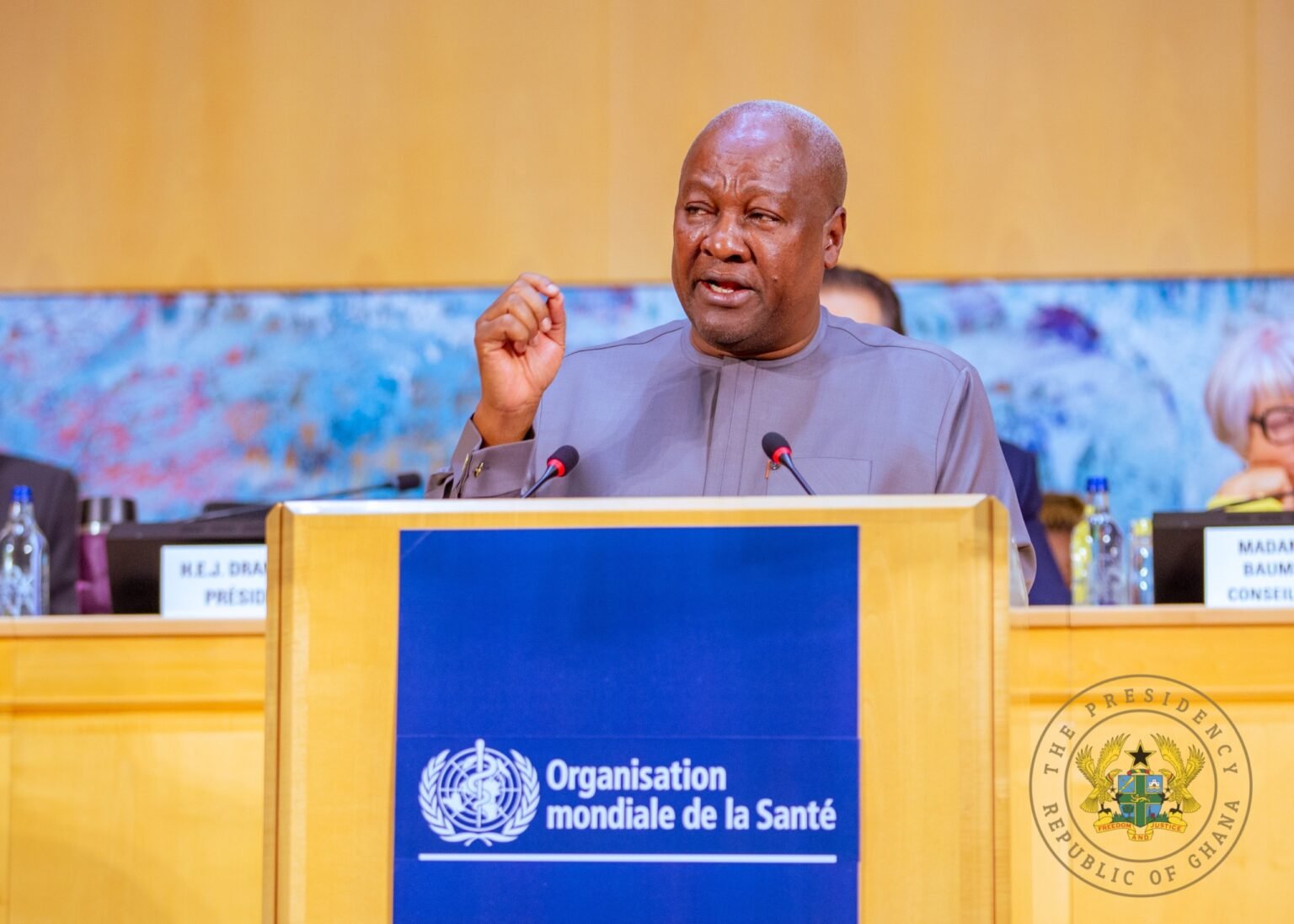
President John Dramani Mahama has called on African leaders and the global community to begin treating health expenditure as a strategic investment directly tied to economic growth and national development rather than merely a social obligation.
Delivering a keynote address at the 79th World Health Assembly of the World Health Organisation (WHO) in Geneva, Switzerland, on Monday, May 18, 2026, President Mahama stressed that a healthy population remains indispensable to economic progress.
“We must see health spending as an investment rather than just a social obligation. A healthy population is indispensable to economic progress,” he stated.
Speaking against the backdrop of declining global health assistance and cuts in overseas development support, the President said countries, particularly in Africa and the Global South, must move towards building self-reliant and sustainable health systems.
According to him, recent reductions in humanitarian assistance and donor funding had exposed the vulnerabilities of health systems heavily dependent on external support.
He revealed that Ghana lost approximately $78 million following the closure of USAID programmes, affecting key sectors including malaria interventions, maternal and child health, nutrition, HIV/AIDS testing, and antiretroviral drug delivery.
President Mahama noted that the changing global health landscape informed the convening of the African Health Sovereignty Conference, popularly known as the Accra Reset Initiative, in August 2025.
He explained that the initiative seeks to promote “health sovereignty” by empowering countries to finance their own health systems, regulate quality standards, manufacture essential medicines locally, and reduce dependency on donor-driven structures.
“I come from a continent that has too often been the subject of global health policy rather than its author,” he said.
Highlighting Ghana’s domestic health reforms, President Mahama said the government had moved beyond rhetoric by implementing policies aimed at placing citizens at the centre of healthcare delivery.
He disclosed that Ghana’s National Health Insurance Scheme (NHIS) had achieved an estimated 66 per cent coverage rate by the end of 2025, while the government had also launched a Free Primary Health Care Programme to expand access to essential services, particularly in rural communities.
The President further stated that the removal of the cap on the National Health Insurance Fund had unlocked an additional GHS3 billion, equivalent to about $300 million, for healthcare investment.
He added that the government had streamlined NHIS operations through digital reforms and the use of artificial intelligence to detect fraudulent claims while ensuring prompt payments to healthcare providers.
“A health insurance scheme is only as strong as the trust between the state and the hospitals that provide the care,” he noted.
President Mahama also highlighted the launch of the Ghana Medical Trust Fund, also known as MahamaCares, to support patients suffering from non-communicable diseases including cancers, cardiovascular conditions, liver disease, and renal failure.
According to him, Ghana’s 2026 national budget had committed GHS34 billion to the health sector while expanding healthcare coverage to about 20 million people.
The President urged global leaders to pursue bold reforms within the international health architecture, warning against protecting institutional interests at the expense of human survival.
“We cannot prioritise institutional comfort over human survival,” he stressed.
President Mahama further called for greater investment in resilient healthcare systems, local pharmaceutical manufacturing, and sustainable supply chains across the Global South.
He emphasised that the success of global health reforms should ultimately be measured by improved healthcare outcomes for ordinary citizens rather than international conferences and declarations.
Source: Starrfm.com.gh