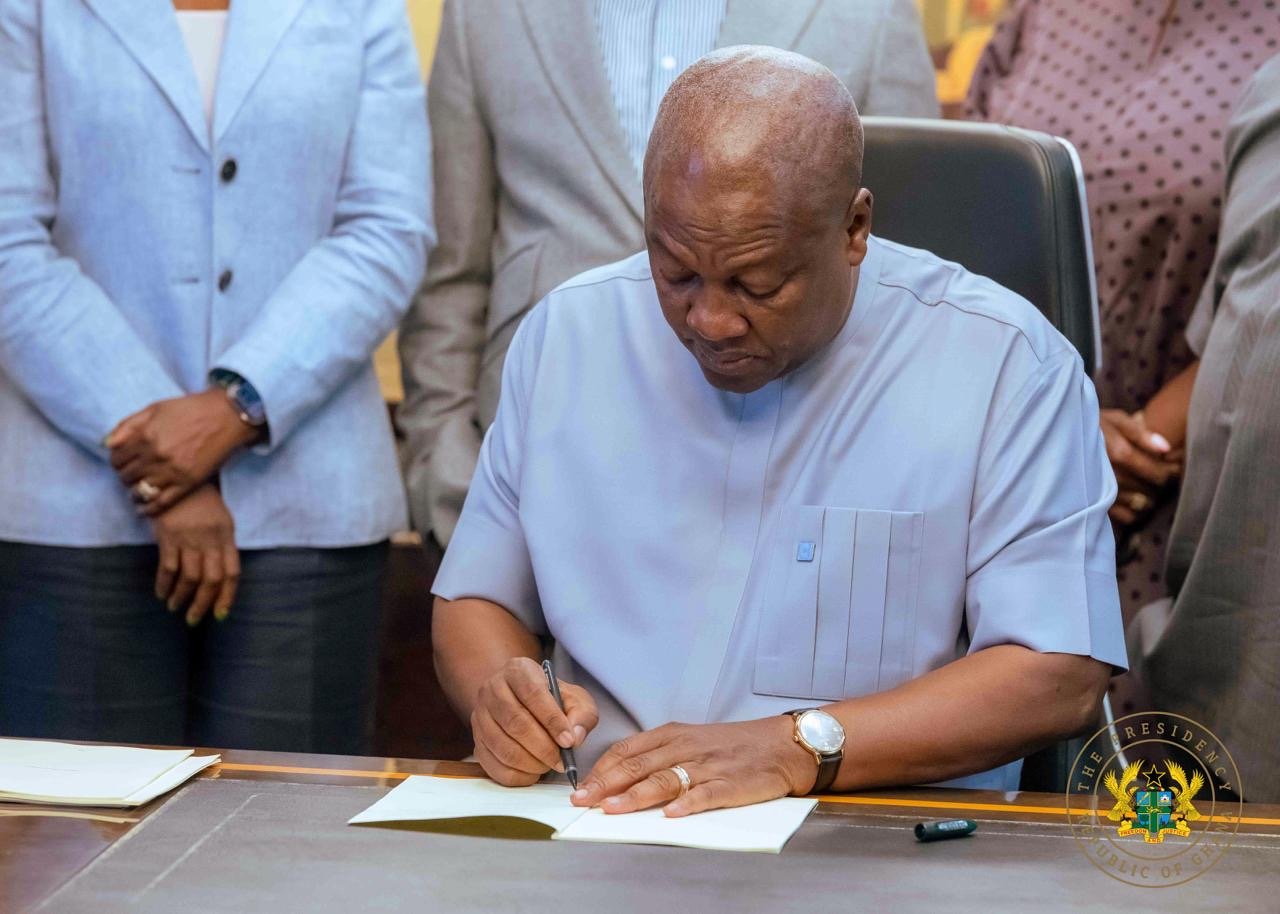
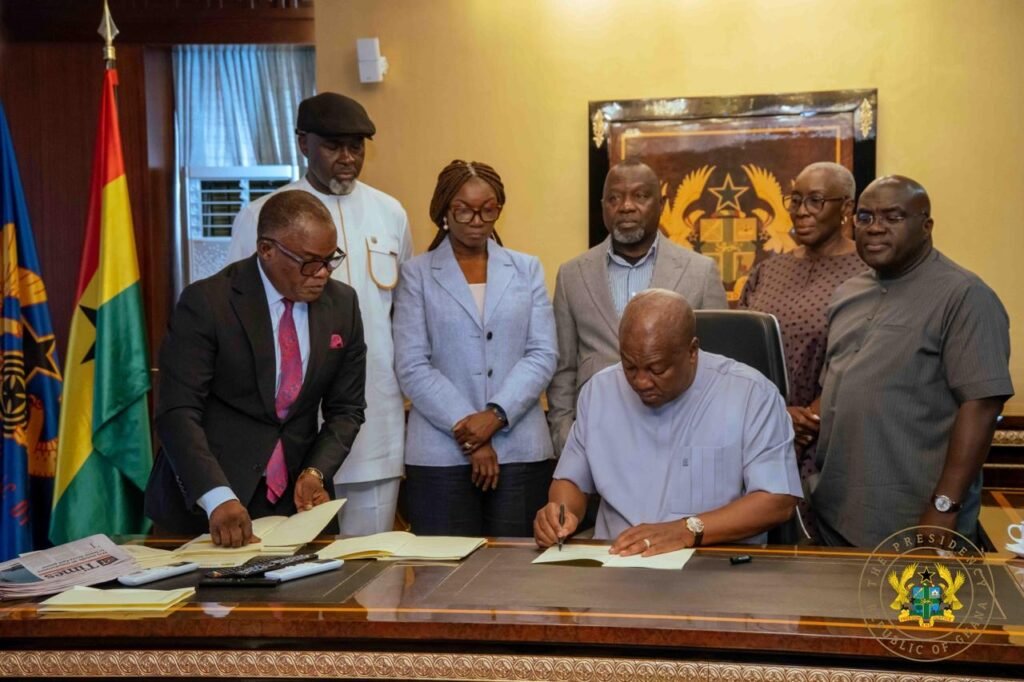
President John Dramani Mahama has assented to five bills passed by Parliament, including three amendment bills, marking a significant step in legislative reforms across security, education, and finance.
Announcing the development, President Mahama stated that one of the key legislations, the Security and Intelligence Agencies Act, 2026, abolishes the Office of the Minister of National Security. According to him, the new law “removes the Office of Minister of National Security and frees the President’s hand to appoint any minister to supervise the security agencies.”
He further explained that the Act also restores the former name of the National Intelligence Bureau to the Bureau of National Intelligence (BNI). “It also reverts the name of NIB… to Bureau of National Intelligence, and so it becomes BNI again, so that it sorts out the confusion between that security agency and a very well-known Ghanaian commercial bank,” he said.
The President also signed into law the University of Engineering and Agricultural Sciences Act, 2026, which establishes a new university in the Eastern Region. He noted that the institution will have three campuses: a main campus at Bonsu, a second campus at Oahu, and a third at Acherenswa in the Ahafo Region.
Another key legislation is the amendment to the Growth and Sustainability Levy Act. President Mahama indicated that although the levy on mining companies had been increased from 1% to 3%, the new amendment reduces it back to 1%. “That is the levy on mining companies. It reduces it again to 1% because of the introduction of the sliding scale for royalties,” he explained.
The President also assented to the Ghana Education Regulatory Bodies Amendment Act, which removes the requirement for universities to obtain charters.
Additionally, the Ghana Deposit Protection Amendment Act was signed into law to strengthen financial safeguards. President Mahama noted that the legislation amends an existing framework “that is supposed to guarantee deposits of the public that is held in commercial banks or financial institutions.”
The signing of the five bills underscores ongoing efforts by the government to reform key sectors and improve governance, education, and financial security in the country.
Source: Starrfm.com.gh