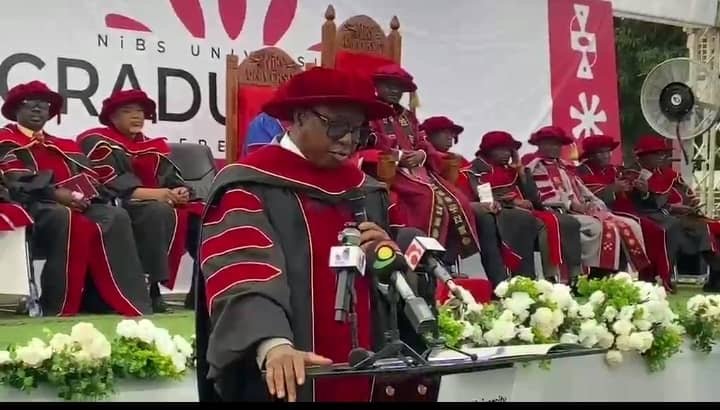
Commissioner of the Commission on Human Rights and Administrative Justice (CHRAJ), Dr. Joseph Whittal, has challenged graduates of NiBS University to pursue excellence anchored in integrity, warning that competence without character poses a threat to institutions and society.
Delivering the keynote address at the university’s graduation ceremony on the theme, “Excellence Beyond Borders: Preparing Leaders for a Changing World,” Dr. Whittal said the world needs leaders who are not only technically competent but also guided by strong ethical principles.
He described the theme as “a demanding instruction” rather than a ceremonial slogan, urging graduates to embrace excellence as a lifelong discipline.
“Excellence is not competence, not adequacy, not the minimum standard that allows one to pass—but the disciplined, sustained pursuit of the highest standard one is capable of,” he said.
According to him, today’s graduates must think beyond geographical and professional boundaries, noting that modern challenges such as climate finance, digital governance, illicit financial flows and pandemic preparedness require leaders who can work across disciplines.
“The most consequential problems of our time do not respect the boundaries between business, law, public policy and technology. Leaders who insist on staying within their lane will be led by those who do not,” he stated.
Drawing from his experience at CHRAJ, Dr. Whittal shared three key lessons from the frontlines of governance: integrity, accountability and inclusion.
He stressed that technical brilliance without integrity can become destructive.
“Competence without integrity is a liability, not an asset. The more capable you become, the more damage your compromises are able to do.”
He also argued that accountability should not be seen as a barrier to success but as the foundation for sustainable leadership.
“Accountability is not the enemy of ambition; it is the discipline that makes ambition sustainable,” he said, urging future leaders to welcome scrutiny and surround themselves with people willing to challenge their decisions.
On inclusion, the CHRAJ Commissioner described diversity as a strategic advantage rather than a compliance requirement.
“Excellence that is not shared, and leadership that does not lift others as it climbs, will not be recognised as excellence by the world you are entering.”
Addressing the changing global landscape, Dr. Whittal said artificial intelligence, climate change and shifting geopolitical dynamics are transforming leadership expectations, making judgment, integrity and trust more valuable than ever.
“The premium is shifting away from those who simply know things toward those who can judge, contextualise, and take responsibility for decisions machines cannot own.”
He further noted that public confidence in institutions and academic credentials has declined, presenting an opportunity for leaders who consistently demonstrate trustworthiness.
“A leader who is demonstrably trustworthy in a low-trust environment does not merely stand out; they become indispensable.”
In his closing remarks, Dr. Whittal charged graduates to ensure their qualifications become tools for service and impact rather than symbols of achievement.
To Master’s graduates, he urged them to apply knowledge with wisdom; to Professional Doctorate holders, he encouraged them to bridge the gap between research and practice; while Academic Doctorate graduates were tasked with producing scholarship that addresses Africa’s development challenges.
He concluded with a call for graduates to make integrity a daily habit.
“Excellence beyond borders is not a single achievement to be collected at commencement and displayed thereafter. It is a discipline you renew every week, in decisions no one else will ever audit.
Character, in the end, is simply what you choose to do when the room is empty.”he added
Source: Starrfm.com.gh/Benjamin Sackey