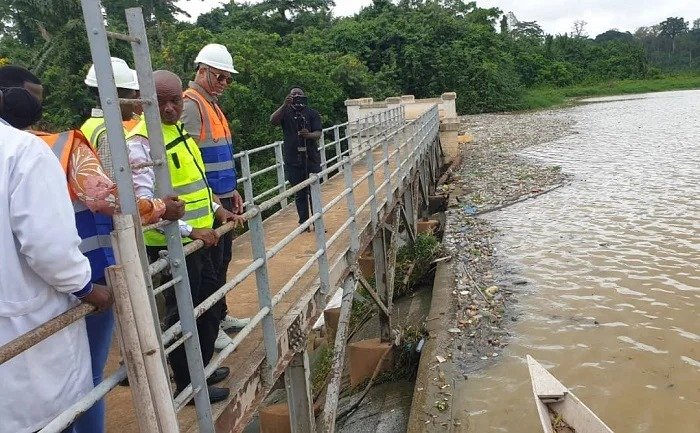
The Managing Director of Ghana Water Limited, Adam Mutawakilu, has warned that the Ashanti regional capital, Kumasi, could face severe water crises in the next few years due to rising siltation and plastic pollution which has significantly reduced the storage capacity of its main water sources.
According to him, a technical assessment of the Owabi Dam and Barekese Dam shows that both reservoirs are undergoing accelerated degradation driven by sediment accumulation, plastic waste inflows, and human encroachment factors that experts say are compromising water quantity and quality.
During an inspection tour of the facilities, Mutawakilu explained that the gradual build-up of sediments have drastically reduced the effective depth and storage capacity of the dams.
At Owabi, large volumes of eroded soil and plastic waste from surrounding communities are washed into the reservoir during rainfall, forming dense layers that limit water retention and flow.
He noted that the visible overflow of water in parts of the dam can be misleading. “What appears as abundance is often a sign of reduced holding capacity due to sediment build-up,” he said, warning that such conditions weaken the dam’s resilience, particularly during prolonged dry periods.
READ: Police launch manhunt for highway robbers who killed Berekum Chelsea player at Ahyiresu
At Barekese, similar processes are underway. The reservoir has reportedly lost a substantial portion of its depth, forcing engineers to draw raw water from higher levels, which are more vulnerable to contamination and seasonal variability. This, he said, increases treatment complexity and operational costs.
From a hydrological perspective, experts warn that reduced reservoir depth accelerates evaporation rates and diminishes buffer capacity during droughts; an emerging risk linked to climate variability.
With rainfall patterns becoming less predictable, reliance on compromised reservoirs heightens the probability of supply interruptions.
Mr Mutawakilu revealed that the utility has applied to the Ministry of Finance Ghana for urgent approval to dredge both dams a process that would restore depth by removing accumulated sediments.
Without such intervention, he cautioned that Kumasi could face critical water shortages within three years.
The Managing Director cited unstable electricity supply as a limiting factor in water production, noting a significant drop in output in March.
However, planned infrastructure support from the Electricity Company of Ghana is expected to improve system reliability.
Supporting these findings, the Ashanti Regional Chief Production Manager of GWL, Hanson Akutteh-Mensah, disclosed that Owabi Dam is approximately 75 per centt silted, while Barekese has lost about 40 per cent of its capacity.
READ: Gov’t has failed to deliver promised jobs – NPP’s Ibrahim Bashiru
He indicated that additional clarifiers are being installed at the Barekese treatment plant to boost daily output.
However, he stressed that technological upgrades alone can not offset the environmental degradation of the water sources.
Environmental analysts point to land-use changes, deforestation, and poor waste management as key drivers of sediment and plastic influx into the reservoirs.
Encroachment near catchment areas reduces natural vegetation buffers that would otherwise filter runoff before it enters the dams.
Authorities have therefore called for a multi-sectoral response, including stricter enforcement against illegal activities around water bodies, improved waste management systems, and public education on environmental protection.
Stakeholders warn that failure to address these underlying ecological pressures could jeopardise water security for millions of residents in Kumasi, with potential consequences for public health, agriculture, and urban sustainability.
Source: Starrfm.com.gh / Isaac Justice Bediako