
In between management meetings this morning, my notifications bell continued to buzz. So, I paused to check. Messages were dropping fast: Bob Hinson says you’re “smearing” GNPC. What’s going on?
There was a link, so I clicked. And there it was, a curious 9-point article by Professor Hinson of the University of Ghana Business School announcing “the true facts” about the GNPC-Aker saga, and gently chiding “a civil society actor by name of Bright Simons” for “misrepresentations”.
“Curious article” because in all the decade and some that I have been involved in energy policy activism in Ghana, Professor Hinson has rarely shown up on the subject. I don’t recall him expressing much interest in any of the raging issues cropping up all the time in the industry.
And curious also because the article comes across as a rejoinder to a bunch of stuff I have written, yet it was published in the Daily Graphic, which has studiously refused to publish any of the work I have done so far on behalf of the CSO movement campaigning against the deal.
Still, Professor Hinson is in the business of helping folks simplify complex ideas for large audiences, so we welcome his late intervention in energy policy matters. It should advance my personal philosophy in policy activism: ripping apart the jargon that so-called technocrats like to hide behind to rip off the country. And, let’s face it, this is a dry subject so the more famous academics we have chiming in, the better our chances for rousing a sleepy national audience.
Now to his 9-point agenda to kill falsehoods and lift the banner of truth. Hopefully, this time around, the Daily Graphic finds it in them to publish this “counter-rejoinder”.
Professor Hinson’s unfamiliarity with the issues showed early on in his nicely formatted but weakly argued piece.
He preambles his 9 points with a sweeping assertion that the Natural Resources Governance Institute (NRGI) has “voted” GNPC as the “best governed National Oil Company (NOC)” in sub-Saharan Africa. He does not provide a year or program/award name. Are we to take it that GNPC was awarded this tribute by the NRGI in respect of all their measurements for all eternity?
The NRGI’s approach to recognizing state performance in this area is via the Resource Governance Index. Everyone can find out what the NRGI thinks of a country and their core institutions by visiting: https://resourcegovernanceindex.org/compare?years=2021
NGRI does not cover all of sub-Saharan Africa in depth. But in respect of oil and gas governance, it rates Senegal, for instance, higher than Ghana (you can verify on the website above):
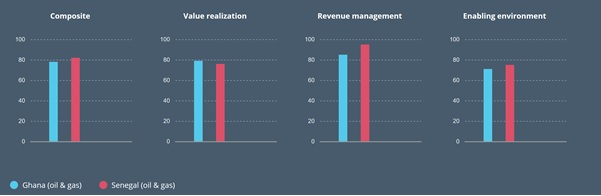
It is very doubtful that the NRGI, considering its standard methodological approach, will coronate GNPC with such an expansive crown as portrayed by Hinson.
Did GNPC Overestimate Long-term Price of Oil to Inflate the Valuation of Pecan-Nyankom?
- Hinson takes issue with my use of $50 per barrel as a long-term price forecast for oil asset valuation. He insists that “not a single” analyst uses this figure. A price assumption in a forecasting model is on a per scenario basis. There is no such thing as a permanent figure that binds entire institutions for all scenarios. It also depends on the time horizon, which in this case is bound by contract tenures in our petroleum regime. It is not CSOs who decided to give the “global energy transition” primacy in this discussion. It is GNPC. Any price forecast worth its salt in this debate must accommodate it wholeheartedly.
A price forecast that takes that phenomenon into account and stretches for as much as 30 years into the future to align with the transaction parameters would differ remarkably from some Morgan Stanley analysis that focuses on short-term dynamics, for example.
We can cut Hinson some slack though, given his historic lack of interest in the subject. Since he seems genuinely unaware of recent long-term forecasts that incorporate parameters relevant to the GNPC-Aker deal, I will point him to this recent one by Wood Mackenzie, which does happily use the $50 per barrel figure – https://www.woodmac.com/reports/upstream-oil-and-gas-long-term-brent-price-held-at-us50bbl-oil-and-gas-price-assumptions-versus-forecasts-33270
For a short-term comparator, he can try the United States Energy Information Administration (which also uses $50):
https://www.eia.gov/todayinenergy/detail.php?id=46516
Of course, one of the important parameters in the transaction under discussion is finding a benchmark blend that proxies the liquids expected from Nyankom and Pecan. WTI and Brent are as good as any for our current purpose, so I will also point Hinson to Fitch:
McKinsey prefers to hedge “between $50 and $60”: https://www.mckinsey.com/industries/oil-and-gas/our-insights/global-oil-supply-and-demand-outlook-to-2040
Then there is the issue of whether to use nominal or real analysis, considering that the Lambert Advisory valuation matrix already uses a Present Value computation.
A small piece of advice for the eminent Professor Hinson: next time he wants to use “never” in a quasi-academic monograph, he would do well to, at least, consult a few databases, or as they say in his line of work, conduct some basic literature review, before being so categorical.
Are the Norwegian Billionaires Due for a Potential $1 Billion Windfall?
- 2. Professor Hinson also disputes the $1 billion windfall number. I had in various commentaries argued that should GNPC have its way, the Norwegian billionaire (Kjell Inge Rokke) who controls Aker and his family would be making a billion dollar windfall in their decade-plus dealings with Ghana.
In disputing this, Hinson limits himself to the farm-out price of $1.1 billion that Rokke wants to flip pieces of both assets to Ghana for and the costs he has incurred so far. But even here Hinson gets the arithmetic hopelessly wrong. Rokke is not selling the entire stake he picked up for approximately $200 million three years ago. He is retaining nearly 30% (crude composite residual) and also waiting quietly to offset the proportion of costs linked to that residual equity against future taxes. Not to talk of the displacement of costs to GNPC through the proposed arrangement of Aker buying the FPSO and renting it at inflated prices to the proposed consortium.
Professor Hinson seems so unfamiliar with petroleum accounting fundamentals that he ruins a good debate with such weak framing.
Has GNPC been helping Aker-AGM to Misrepresent their Costs in Ghana?
- 3. Hinson’s strange response to our argument that Hess, Aker and TRG discloses their costs through filings in more stringent jurisdictions and as such we are better served in using those filings as our best source of truth is to airily wave his hands away.
He insists that those filings do not include a bunch of costs the international oil companies (IOC) incur in Ghana, and which they choose to disclose only to their friends in the GNPC. GNPC has in fact recently talked about a “data room” set up specifically for them to “audit” those costs.
In case Professor Hinson doesn’t know, GNPC is not a regulator in the petroleum industry. It is not the Ghana Revenue Authority. And it is neither an auditing entity nor an audit standards regulator of any kind. Whatever sweetheart arrangement it has with Aker and Inge Rokke for the latter to selectively disclose data about costs to it but not to their own regulators in their home countries has no real import in this analysis. We prefer to use data disclosed in stringently regulated jurisdictions where such sweetheart arrangements are not trumpeted as evidence of rigour.
Does Professor Hinson Even Know Which Aker We Are Talking About?
- 4. Prof Hinson is not happy that we will highlight the irony of a GNPC founded in 1983 seeking to pay large amounts of money it can’t spare for the privilege of understudying an Aker founded in 2004. He insists therefore that Aker has been in operation for more than 175 years.
Given Hinson’s sudden interest in the issue, it is not too surprising that he would not know that the Aker that was founded in the 19th century is not the one this debate is about. That despite the complex historical evolution of the Aker brand, the Aker under discussion is the one incorporated in 2004 in Norway, as can easily be established by a reference to the Oslo registry of companies (https://www.nor47business.com/en/company/Aker-Asa).
Professor Hinson’s eminence notwithstanding, his latest essay does not, respectfully, vindicate his research prowess. At least, he could have referred to Aker’s own press releases for a simplified narrative of the matter (example: https://newsnreleases.com/2020/11/22/aker-asa/).
Did the Lambert Advisory Valuation Rely on Anything More than GNPC and Aker’s Self-Serving Numbers?
- 5. I was on the call with Rajeev Madhavan of Lambert Advisory, the firm’s whose valuation is being currently relied upon by the Government to raise the $1.45 billion for the deal, when he candidly informed his CSO audience and, in specific responses to questions from Dr. Theo Acheampong, reaffirmed that he did not have the opportunity to interview the qualified reserves auditors (QRAs). He also openly admitted the fact of his not having been given access to the actual audit reports. The entire valuation exercise had a timeline of two weeks after all. In fact, considering that Nyankom hasn’t even been audited, the only field where “third party reservoir data” can even be referenced in this discussion is Pecan. Rajeev stressed that his analysis was strictly based on the “operator’s case”, meaning information he has been supplied by GNPC and Aker-AGM, who commissioned his employers, Lambert.
Hinson mentions anonymous sources in the “civil society space” who have told him otherwise. We advise him to contact Lambert Advisory or his friends at the GNPC for the zoom recordings.
What is Hinson Going on About Regarding “Physical Merger”?
- 6. The most bizarre of all the lacklustre arguments served up by Professor Hinson is a “rebuttal” to a claim I had purportedly made about Nyankom and Pecan being “physically merged”. I have been around the energy policy space for more than a decade. I have never experienced an argument about the “physical merger” of two license areas being developed as a joint asset. The concept makes no sense.
Everyone knows that a “merger”, using the term loosely, of two fields in the petroleum sector invariably involves a range of scenarios: merger of the leases (which Hinson, ever the guru on Ghanaian petroleum affairs, assures us is impossible despite the plenary powers of Parliament), unitization for optimal recovery (which strictly speaking does not require reservoir straddling under Ghanaian law), or tie-backs and other mechanisms to enable the sharing of production platforms and associated infrastructure. The merger of Nyankom and Pecan in the context of this conversation can only refer to the plans shared on slide 26 of the GNPC’s presentation to the Economic Management Team about “merging” the operatorship of the two fields.
Therefore, that whole line about someone talking about the oil fields being physically blended together with giant shovels is a waste of everyone’s time.
Are there Stranded Assets in Ghana that Offer Better Value than Nyankom?
- 7. For an article that sets out to address “misrepresentations”, it takes the biscuit for the author to blatantly resort to the same thing complained of in an attempt to win a debate. I have never said that there are stranded oil discoveries in Ghana that have more oil than “both” the Nyankom and Pecan fields.
The reference I made was specifically to Nyankom, a risky, unappraised, field that may well not even be commercial. I said that Wawa, the Erin find and Akasa all have more estimated resources than Nyankom. We used the IHS Resource Ranking database in conducting our assessment and it underlies our assertion. This is the same database relied upon by Lambert, the GNPC and Aker’s preferred valuer. On this one, Professor Hinson is thus out on a limb and, dare I add, out of his league.
Has Aker Added Enough Value to the Blocks it Bought to Deserve the Windfall?
- 8. No one disputes that since Aker’s re-entry into the Ghanaian upstream sector, it has made some investments, some of which have added value to the country’s resource profile. The truth however is that as far back as 2012, Hess had conducted a detailed appraisal of Pecan and established most of what we now know about the reservoir. When Aker bought the Hess acreage in 2018, 2C volume estimates were already pegged at 550 million barrels, with a 400-million barrel upside (see: https://www.globenewswire.com/en/news-release/2018/06/01/1515310/0/en/AKER-ENERGY-AKER-ENERGY-BECOMES-OPERATOR-OF-THE-DWT-CTP-BLOCK-IN-GHANA-AFTER-ACQUIRING-HESS-GHANA.html).
Just before Aker started to look for a buyer for 50% of the Pecan asset in June 2021 because of the funding challenges it was facing (see: https://www.riglynx.com/aker-energy-looking-to-sell-50-of-ghana-deepwater-prospect), and around the time it suspended its Final Investment Decision on the field, its prospectuses were still bandying around the same resource levels (see, for instance: https://www.euro-petrole.com/aker-energy-issues-letter-of-intent-to-yinson-for-fpso-n-i-21702) and, earlier: https://jpt.spe.org/aker-energy-submits-plan-develop-oilfield-offshore-ghana).
Nyankom, on the other hand, is yet to be appraised. A single discovery well does not a commercial oil field make. So, at this point, the true value created remains speculative.
- 9. The last point in Professor Hinson’s 9-point thesis is totally incoherent. He says that Aker/Rokke have not changed their mind about spending $4.5 billion nor have they decided to lower their risk by spending $2.5 billion instead. But this is not a secret at all. Aker has publicly stated that the initial Plan of Development capital expenditure has been revised lower by 50%, meaning $2.2 billion. Adding contingency takes the number to roughly $2.5 billion (see, for instance: https://www.reuters.com/business/energy/aker-energy-aims-submit-revised-plan-pecan-field-by-end-2021-2021-07-16/).
That difficulties in fund-raising have led to radical revisions to Aker’s plans in Ghana is so widely known that had Professor Hinson been even half-attentive in this space he would not be picking a fight on this point.
As I said in the beginning, the CSOs active in the energy activism and advocacy space strongly welcome the interventions of Ghanaian academics in this debate, particularly those like Professor Hinson who have expertise in simplifying the issues to attract broader interest. Let’s admit it, this debate could do with much more public interest.
We only ask that they take a bit of time to understand the issues, do the research and then engage so that they can be fair to those of us with perspectives opposed to the stance of their friends at the GNPC. Not too much to ask for, I hope.
Further Reading
Bob Hinson’s 9-Point Agenda: https://www.graphic.com.gh/features/opinion/top-9-misrepresentations-about-moves-to-increase-offshore-oil-blocks-discussions-around-the-real-facts.html
Backgrounder: https://www.theafricareport.com/115932/why-is-ghana-giving-1bn-to-big-oil-in-norway/